Cato Institute
1000 Massachusetts Ave, NW
Washington DC 20001-5403
Phone (202) 842-0200
Fax (202) 842-3490
Contact Us

Cato Store Home >> Books >> Law and Civil Liberties

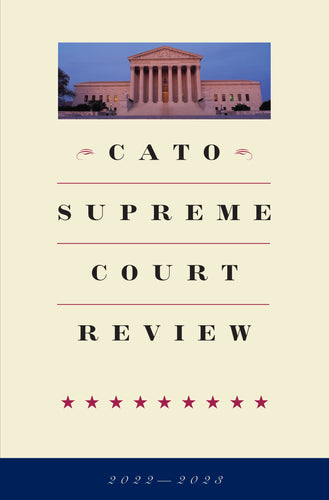
Cato Supreme Court Review, 2001-2002 (Paperback)

Edited by James L. Swanson

Cato Supreme Court Review, 2001-2002 (Paperback)


A timely review of the Court's recent decisions.

Price: $5.00
Publication Date: September 2002
ISBN: 1-930865-35-X
Number of Pages: 270
Paperback (also available in E-Book)
Categories: Law and Civil Liberties


You might also like...

The Rule of Law in the Wake of Clinton (Paperback) If you like this title, you might also enjoy The Rule of Law in the Wake of Clinton (Paperback).

Save 20% when you buy them together.


About the Book

The Cato Supreme Court Review is an annual critique of the Court's most important decisions from the term just ended, plus an incisive look at the cases ahead.

The Cato Supreme Court Review is unlike any other publication that follows the Court. First, it is timely. It is the first review of the Court's most recent term. Second, it is written not just for legal experts but also for the educated public. Finally, its perspective is unique. In a collection of essays by scholars, lawyers, and Supreme Court litigators, it examines the Court's decisions and its upcoming cases in light of the nation's first principles -- liberty and limited government -- as articulated in the Declaration of Independence and secured by the Constitution.

This edition of the Review includes articles on property rights, the First Amendment, child pornography, federalism, crime, the war on drugs, school choice, and political speech. Contributors include Clint Bolick, Robert Corn-Revere, Richard A. Epstein, Stephen P. Halbrook, Eric S. Jaffe, Robert A. Levy, Timothy Lynch, Roger Pilon, James L. Swanson, and Jonathan Turley.

All chapters from this edition are available for download in PDF format.

[ TOP ]


About the Editor

James L. Swanson is a senior fellow in constitutional studies at the Cato Institute.

[ TOP ]


What Others Have Said

"The new Cato Supreme Court Review promises to critique the work of the Supreme Court from the classical Madisonian perspective. This should provide a valuable addition to the literature on this important American institution."
--Richard L. Thornburgh, United States Attorney General under Presidents Ronald Reagan and George H. W. Bush

"The Constitution’s grand guarantees of liberty and equality are neither self-explanatory nor self-executing. In their actual impact on our private lives and public policy, they are as strong -- or weak -- as the Supreme Court makes them. Therefore, all friends of freedom must maintain special vigilance over the Court. This new Cato Supreme Court Review promises invaluable insight and inspiration for that vital task."
--Nadine Strossen, President, American Civil Liberties Union; Professor of Law, New York Law School

"The inauguration of the Cato Supreme Court Review is welcome, hopeful news. The Court’s vital work will now be rigorously critiqued against basic principles -- the enumeration of powers, the Takings and Contract Clauses -- that have been out of fashion in legal circles but were fundamental to the Founders in checking governmental encroachments on individual liberty."
--Charles J. Cooper, Assistant Attorney General, Office of Legal Counsel, under President Ronald Reagan

"The new Cato Supreme Court Review raises great expectations, and rightly so. Debate over the role of the Court and analysis of its critically important decisions will be immeasurably enriched by Cato’s fresh perspective and commitment to principles of liberty."
--Walter Dellinger, Assistant Attorney General, Office of Legal Counsel, and Acting Solicitor General under President Bill Clinton

[ TOP ]


Read Excerpts


Introduction

School Choice

[ TOP ]


July 30, 2010
Buy Now!
Online Book Specials
Buy online today
or
Buy by phone at 800-767-1241
Cato Institute • 1000 Massachusetts Avenue, N.W. • Washington D.C. 20001-5403
Phone (202) 842-0200 • Fax (202) 842-3490
All Rights Reserved © 2010 Cato Institute